

Perfectly ripe mangoes are one of the most delicious fruits you could ever eat! Although there are different cultivars, and a variety of different skin colors, there is a commonality among ripening in all types of mangoes, and once you master this, selecting, ripening and eating mangoes will be a breeze! This post is all about how to select and store mangoes in order to be able to enjoy them to their fullest.
(This post is an excerpt from The Produce Nerd’s Grocery Guide, with input provided by Rita Nassur, who used to be a Professor and now works in Research & Development, and specializes in mangoes, among other fruit. You can learn more about the Grocery Guide, which covers this information for 55 different produce items, with input from 26 crop-specific companies HERE.)
Table of Contents
How to Select Mangoes
What to look for when picking the best quality mango?
- For mango, color is not always the best quality index. It depends on the cultivar. So, a simple way to pick the best fruit is to gently squeeze the middle part of the fruit. If it is a little soft, the mango is ripe and will probably have the best sensory characteristics.
Common issues to avoid when selecting mangoes?
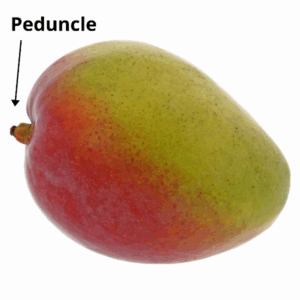
- It is important to look at the peduncle insertion to make sure there is no sign of fungi development, and that the insertion is tightly closed. Besides that, it is important to check for any bruising.
Are there any common issues that are specifically caused by bad grocery store handling?
- The worst problem is the transportation temperature and time, but these issues will become evident when the fruit is out on display at the grocery store (even though it was caused from issues experienced before the grocery store) and when it is cut.
Are there any new cultivars that are being grown that might have different quality indicators or common issues to look out for?
- Some new cultivars from Israel (e.g., Shelly) are being produced, but the quality indexes are pretty much the same than the mangoes already on the market.
Are there any common things that consumers should look for not mentioned above?
- It is important to understand that color is not a good quality index, since each mango cultivar varies regarding the skin and flesh color, and consequently fiber amount and sweetness.
How to Ripen Mangoes
How to ripen mangoes at home?
- If your mango is really firm (which is common on the grocery display), you can set it out on your counter to ripen. You can speed up this process, by placing the hard mangoes with other climacteric fruit, which continues ripening after harvest, such as bananas, apples and pears. Or, you can just leave them on the counter by themselves and they will ripen, although it will take a little bit longer.
How to tell if a mango is ripe?
- Mangoes are similar to peaches and avocados, where their ripeness can be determined by how much the fruit gives when you give it a little squeeze. The more it gives (moves when you squeeze just a bit), the riper the fruit is. This is something you will need to practice a bit to adjust to your taste preferences because if the fruit gives just a little bit, it probably isn’t ripe enough and won’t be as sweet. However, if it gives a little more, it will be just the perfect ripeness and sweetness, but if it gives too much, it can be overripe and start to have a fermented taste (and also be harder to cut).
Can mangoes continue ripening after being cut?
- Unfortunately not! Once mangoes have been cut, that is the ripeness that they will be until they are eaten or discarded.
- That is also unfortunately why some containers of fresh-cut mangoes at the grocery store do not always have fully ripened mangoes. It is user error, just like what could easily happen to us at home too if we don’t wait for the mangoes to get soft enough to cut into!
How to Store Mangoes
What is the best way to store mangoes at home?
- You can store mangoes on the counter or the refrigerator. You would want to store them on the counter if you want them to ripen them further (measured by the softness) or if you plan on eating them quickly.
How to store ripe versus unripe mangoes?
- Ripe mangoes should be stored in the refrigerator, so they do not get overripe on the counter, and also because they are so delicious a little bit cold!
- Unripe mangoes should be stored on the counter until they have ripened (softened up). You can just set them on the counter to ripen and wait a few days, or if you would like to speed up the process, place them next to other ripening fruit (climacteric fruit), such as bananas, apples, pears, etc.
What is the best way to store cut mangoes at home?
- If the mangoes have been cut into pieces, put them into an airtight container and store them in the refrigerator.
What is the best way to freeze mangoes?
- Before putting mangoes in the freezer, you will want to cut them into bite-size pieces and store them in an airtight container. You can either use something similar to a Ziploc freezer bag or a Stasher Bag. Both will hold up and since the mango has already been cut into bite-size pieces, it will be really easy to take out and use when desired.
What are signs of an overripe mango?
- An overripe mango will feel like it’s too soft, or that it gives too much. It can also have a sort of jelly or super fibrous texture on the inside that is hard to cut, depending on the cultivar. As well as, it could also start to have a fermented taste to it.
- However, as long as the flavor is good on the inside, make sure to still enjoy it! If you can’t cut it into pieces, a smoothie is another great option.
What is your favorite way to eat and prepare mango?
- We love to eat fresh mangoes as a midday snack, in salads and also as juice. We always have some frozen pulp in the fridge.
If you enjoyed this post, you might also be interested in: