

Mushrooms are delicious, and can be thoroughly enjoyed both raw and cooked. The detailed description below is meant to help make the process of selecting different types of mushrooms easier, and to simplify the process so that you can have a more pleasurable eating experience. This post is all about how to select and store mushrooms, in order to be able to enjoy them to their fullest.
(This post is an excerpt from The Produce Nerd’s Grocery Guide, with input provided by Monterey Mushrooms. You can learn more about the Grocery Guide, which covers this information for 55 different produce items, with input from 26 crop-specific companies HERE.)
What to look for when picking the best quality mushrooms?
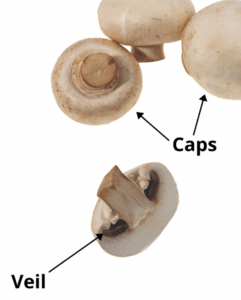
- The caps should be firm and have a uniform color.
- If you are looking for an “earthy” taste, look for thick/dark veils. If you are looking for a “delicate” flavor, look for thin/light veils.
- Choose mushrooms that are dry (you do not want slimy mushrooms!).
Common issues to avoid when selecting mushrooms?
- Non-uniform color
- Moist mushrooms
- Mushrooms that are stored near onions, garlic or any fruit that gives off ethylene (these will cause them to go bad quicker).
Are there any common issues that are specifically caused by bad grocery store handling?
- Mushrooms that are stored near onions or garlic can absorb their flavor.
- Bruising can be caused from stuff being stacked on top of the mushrooms.
- If mushrooms are placed in an area where it is easy for them to get wet (e.g., near misters or iced product), they can become discolored and/or go bad quickly.
- If mushrooms are stored at too warm of a temperature, their respiration rate will increase and they will go bad quicker.
Are there any new cultivars that are being grown that might have different quality indicators or common issues to look out for?
- Monterey Mushrooms has “high vitamin D” mushrooms, where one serving (~5 medium-sized mushrooms) gives you 50% of the FDA’s daily recommended amount of vitamin D that you should be consuming. This added amount of vitamin D is caused from the mushrooms being exposed to a specific UV wavelength, where the naturally occurring ergosterol (pre-vitamin D) is converted to ergocalciferol (vitamin D2). You can find these specific mushrooms by reading the label, as these mushrooms have “high vitamin D” on the label.
What is the best way to store mushrooms at home?
- Loose mushrooms – Place them into a brown paper bag (not plastic) and fold it closed.
- Packaged mushrooms – Keep them in the refrigerator in the original packaging from the store.
- Frozen mushrooms – If you want to freeze mushrooms, do not freeze them raw. Instead, sauté them and then freeze them. These should be good in the freezer for up to one month.
What is your favorite way to eat and prepare mushrooms?
- Stuffing portabellas with items you’d normally top a pizza crust with – for example, portabella pizzas.
If you enjoyed this post, you might also be interested in: