
I understand that you probably landed on this post because you are concerned about how lettuce (and probably all leafy greens) is handled, whether it is safe to eat, how growers ensure it is safe to eat, and what you can do as a consumer to do your part.
After featuring multiple leafy green growers over the years, showing their processes step-by-step, and partnering with the Leafy Green Marketing Assocation (LGMA – both California and Arizona teams) to showcase the food safety side of leafy green producers, I would like to showcase it all for you here to help make the case of why you should feel safe eating all types of leafy greens and lettuces, especially those that are grown in California and Arizona.
Table of Contents
Who Oversees Leafy Green Food Safety Programs?
When you are a leafy green grower, you don’t just get to grow your product and then sell it to anyone. When you want to sell your product to a grocer or a restaurant, they will always ask to see a copy of at least your most recent food safety audit to see how your growing operation performed. Those audits are third party audits that are performed by a company that the grower has to pay to come out and perform the audit. This is typical for all produce items, but when it comes to leafy green products, there are even stricter standards put into place that most growers in California and Arizona choose to participate in. This additional program is extra oversight from the LGMA (Leafy Green Marketing Association).
What is the LGMA?
There are two LGMA programs, one in California and one in Arizona, which are the main leafy green growing regions in the United States, and those programs are basically one in the same. This is not a mandatory program, but over 90% of leafy green growers in those two states opt in to participating. As part of the membership, growers receive additional audits, this time from a USDA-certified government auditor, and must receive 100% compliance on their audits.
It is essentially an extra enforcement of food safety and food safety practices implemented on the farm, and is backed by science.
What crops are covered by the LGMA?
Crops covered by the LGMA include:
- Arugula
- Baby leaf lettuce
- Butter leaf lettuce
- Green cabbage
- Red cabbage
- Savoy cabbage
- Chard
- Endive
- Escarole
- Green leaf lettuce
- Iceberg lettuce
- Kale
- Red leaf lettuce
- Romaine lettuce
- Spinach
- Spring Mix
What does it mean to be LGMA Certified?
In order to be LGMA certified, members agree to practice the food safety requirements put forth by the LGMA, including having multiple audits per season, taking actions on all non-conformities found (these are issues that are discovered during those audits), and committing to continuous improvement.
Why LGMA Growers Invest in Food Safety?
Leafy green growers buy into food safety because the cost of not doing food safety is so large, and all of these practices are put into place to prevent the real cost of not doing it, which is really sick people, medical bills, lost lives, and much more.
Some of the additional food safety costs that are included into the farming operations are: having a food safety staff, water and product testing, audits, extra paper work, sanitizing harvesting tools, proper hygiene and sanitation for workers, and having traceback labeling and procedures in place.
All of this is done to protect the consumer from having any issues with the product.
Personal Protective Equipment (PPEs) Used While Harvesting Leafy Greens
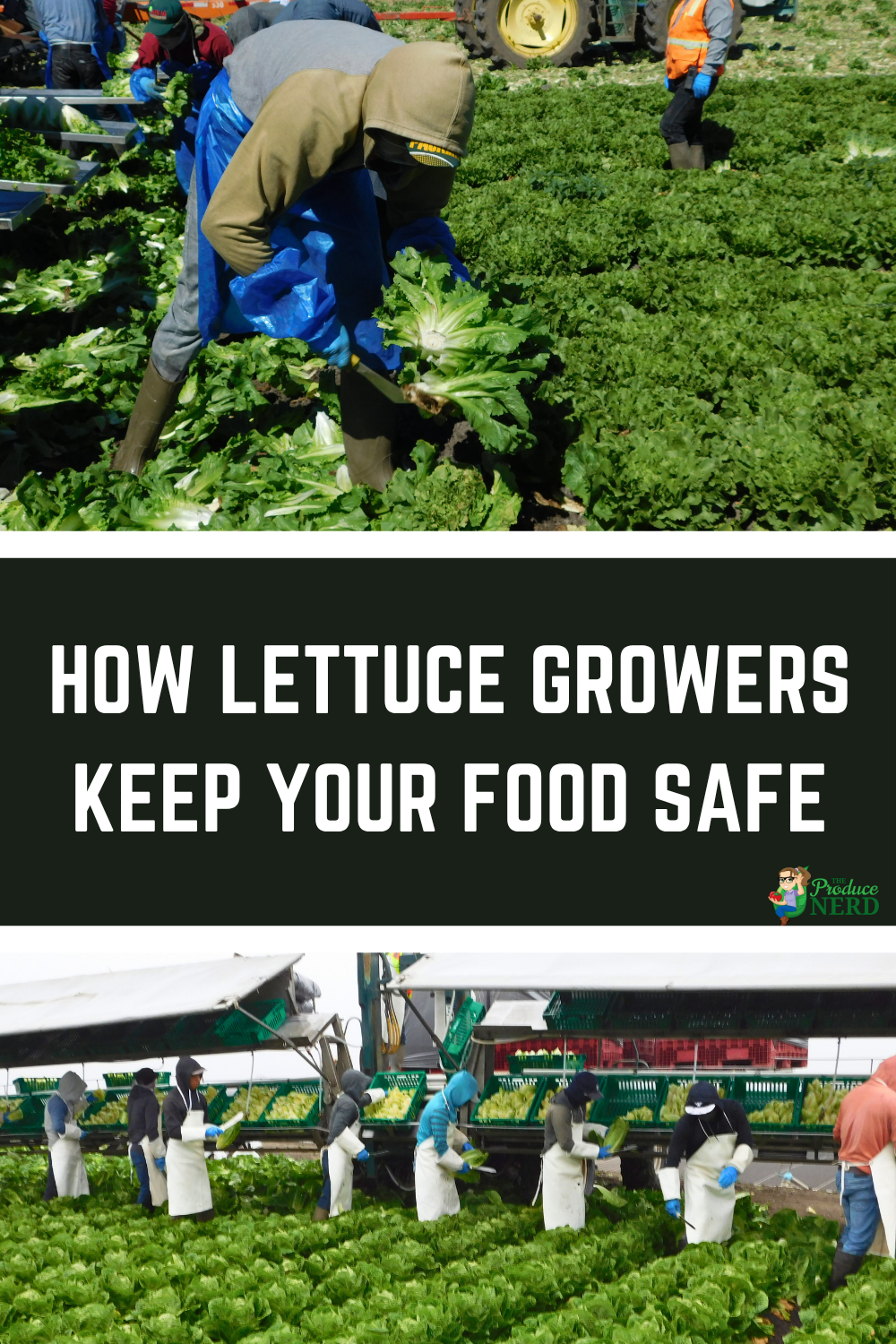
When harvesting leafy greens, there are a ton of food safety considerations that go into place, including the workers needing to wear personal protective equipment (PPEs) while harvesting.
In the specific harvesting example in the video below, these leafy greens are being harvested and will be further processed. For those products that are intended to be further processed, LGMA guidance requires the following PPE: aprons, gloves, hair/beard nets, and sleeves. For other products not intended for further processing, the PPEs could be as minimal as gloves and hair/beard nets.
Cleaning & Sanitizing Harvesting Rigs
There are seven steps that go into sanitizing harvesting rigs:
- Dry Cleaning – Where the workers go in and remove any visible debris.
- Pre-rinse – All with water.
- Detergent Application & Cleaning – Where they apply the detergent and clean.
- Post-rinse – Where they wash all of the detergent off.
- Inspection – Where the workers inspect their cleaning job.
- Sanitizing – Spray the sanitizer and let it sit for a little bit.
- Pre-op Inspection & Approval – Do a final inspection to approve whether the harvesting rig is ready for use.
In the video below, you can see the step-by-step breakdown of how this works.
Food Safety of Harvesting Knives
Food safety is especially important when it comes to leafy greens. For leafy greens, when they are harvesting out in the fields, they have a knife dip where the knives go during any breaks (it essentially acts as a storage). There is a mixture of water and chlorine in the knife dip, and they have to continually check to make sure that it measures within the correct range.
Each knife has a specific number on it and it matches up with a specific worker, and they get that knife for the entire harvesting season.
This means that every time they take a break, eat lunch, use the restroom, they leave their knives in the knife dip, and then get their assigned knives out of the knife dip once they are ready to get back to work (including when starting their work day).
Product Traceability
You might not see traceback information on every individual leafy green product being sold at the market, but the containers they are transported in contain traceback straight to the field and the day in which they were harvested. All LGMA certified shippers are required to have a traceback system in place, which allows them to traceback any product within an hour or less.
How is Your Lettuce Washed?
With lettuce and other leafy greens that have already been washed and are labeled as such, the reference to “triple-washed” means that the lettuce went through three wash steps in three separate tanks prior to being packaged. Those three steps are as follows:
- During the first rinse, the lettuce goes into an agitating tank to remove any physical debris from the field (e.g., pebbles, soil, etc.). With the high load of debris in this step, more frequent water checks need to occur to ensure that the sanitizer levels are being maintained.
- The second wash is where the product is cleaned, and where the sanitizer (chlorine) helps to control the bacterial limits in the wash water that comes into contact with both the product and the equipment.
- The final rinse step is with non-chlorinated water and is meant to rinse all of the chlorine from the prior two washes and to continue reducing the temperature of the lettuce. Instead of chlorine, the sanitizer typically used in this final rinse is ozone.
How to Wash Lettuce at Home?
If you buy lettuce packs that are labeled as already washed (e.g., “washed,” “triple washed,” “pre-washed,” “ready to eat,” etc.), then they have already been washed and you do not need to do any further washing at home prior to consumption.
However, if you are buying individual items, such as a head of lettuce or a bunch of kale, all you need to do is remove a few of the outer leaves, remove the core, and wash with plain water and dry it, and it’s ready to eat!
I hope all of this information was helpful for you! The LGMA was originally created after a large spinach outbreak in 2007 to help the leafy green industry, and to protect the consumer. So, the next time an issue arises where you start to worry about whether or not you should consume leafy greens, the first thing to consider is where those leafy greens were grown (e.g., such as the United States or Mexico), and then proceed from there using your newfound knowledge of how much work the California and Arizona leafy green growers are putting into their food safety programs to keep your leafy greens safe to eat!
If you enjoyed this post, I would also recommend: